
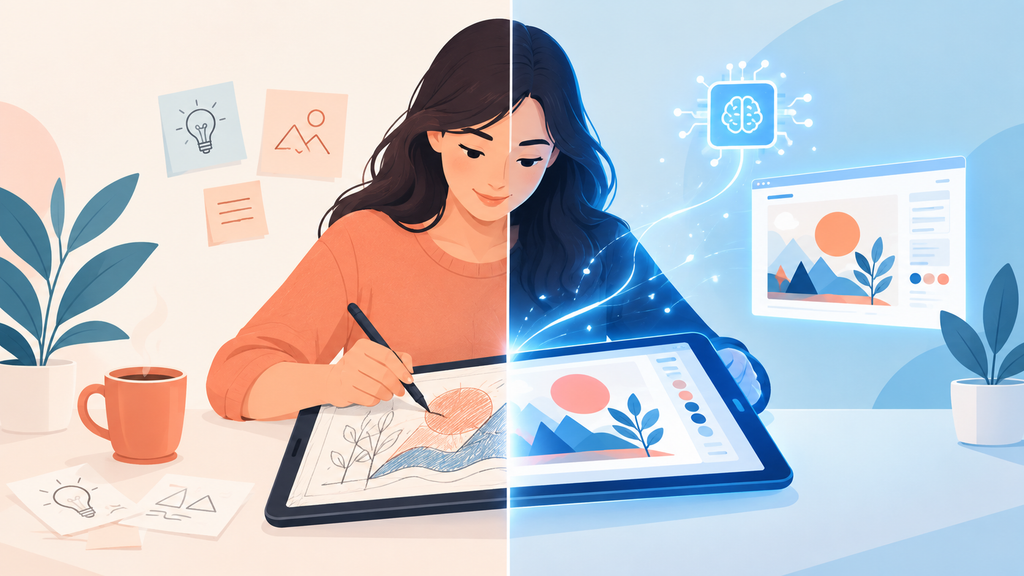
A few years ago, this question felt hypothetical. Now it’s the first thing every client, student, and freelancer wants to talk about. Type a sentence into Midjourney or Adobe Firefly and you get a logo concept, a poster layout, or a full mood board in seconds — work that used to take a designer an afternoon.
So is 2026 the year AI finally takes over graphic design? Short answer: no. Longer answer: the job is changing shape faster than almost any creative field, and understanding how it’s changing matters a lot more than debating whether it’s happening.
How Fast AI Adoption Actually Grew
The numbers tell a clear story. A recent Adobe survey of thousands of creatives worldwide found that the vast majority are already using generative AI in their work, and most of them say it lets them make things they couldn’t have pulled off on their own. Industry-wide, the share of designers using AI tools has more than doubled in just a couple of years — jumping from roughly a third to around three-quarters of the profession.
Businesses are moving just as fast. Recent research on business AI adoption found that nearly nine in ten companies now use some form of AI design tool. But — and this is the part that gets left out of the panic headlines — almost as many businesses still employ human graphic designers, and a meaningful share have actually increased their design budgets rather than cut them.
Adoption and replacement are two very different things.
What AI Actually Does Well in 2026
AI has become genuinely excellent at the repetitive, mechanical parts of design work:
- First-draft concepts and mockups — generating ten directions for a layout or logo in the time it used to take to sketch one
- Photo cleanup — background removal, upscaling, retouching, and image restoration
- Reformatting — resizing one design across a dozen platforms and aspect ratios automatically
- Color and typography suggestions — matching palettes and fonts based on a brand or mood
- Rapid ideation — testing variations before committing real production time to one direction
Different tools have carved out different lanes: Adobe Firefly for teams already living inside Photoshop and Illustrator, Midjourney for highly stylized concept art and mood boards, Canva’s Magic Studio for fast social and marketing content, and Figma AI for UI/UX systems and prototyping. None of them is “the” design tool — they’re each good at one slice of the workflow.
Where AI Still Falls Short
Here’s where it gets interesting. AI can generate images. It cannot yet:
- Understand why a brand looks the way it does, or what it needs to say to a specific audience
- Sit with an ambiguous, half-formed brief and ask the right questions to shape it
- Read a client’s hesitation in a feedback call and know what they’re actually asking for
- Make a judgment call about what to cut, what to keep, and why it matters
- Build the kind of visual consistency and storytelling that makes a brand feel like one thing across a website, a social feed, and a printed invitation
The disruption so far has landed hardest on the most commoditized end of the industry — stock photography sites, for instance, have reportedly seen sizeable revenue declines as AI-generated imagery replaces routine stock purchases. That’s a real shift. It’s just not the same as strategic, brand-defining design work disappearing.
What the Job Numbers Actually Say
The U.S. Bureau of Labor Statistics projects modest but positive job growth for graphic designers through the mid-2030s, with tens of thousands of openings expected every year — slower growth than the economy overall, but nowhere near collapse.
Business surveys back this up in a more nuanced way: a meaningful minority of companies report needing fewer designers because of AI, but a larger share report that their design needs actually grew, likely because AI made producing more content commercially viable. Meanwhile, the skills employers ask for are shifting fast — fluency with design tools like Figma is now expected in most listings, motion design shows up increasingly in senior roles, and “AI tool fluency” has gone from a rare mention to one of the fastest-growing requirements in the field.
The Role Is Shifting From Maker to Director
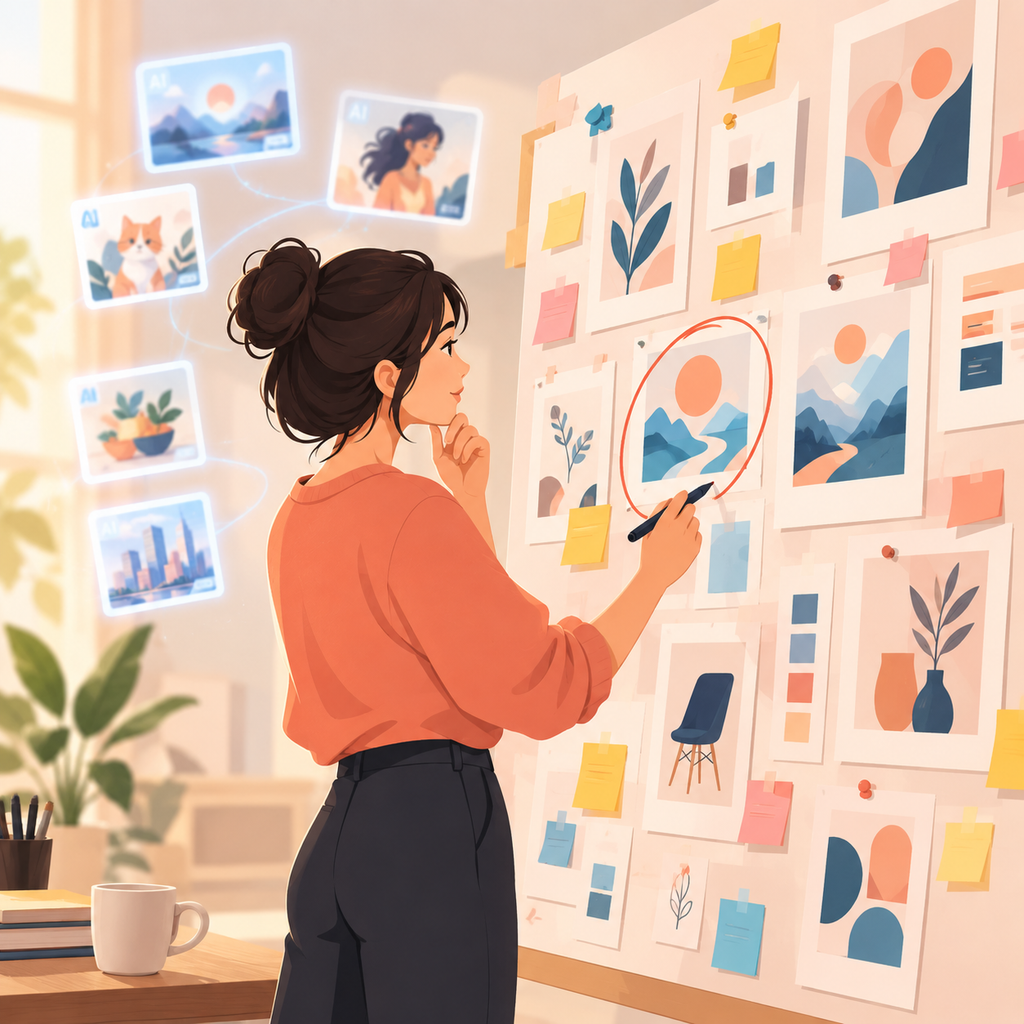
The clearest way to describe what’s happening: designers are moving from making every pixel by hand to directing — briefing the AI, generating options, selecting, editing, and applying the judgment that turns a good-enough output into something that’s actually right for the brand in front of them.
Entry-level production work — the kind that involves executing a known layout over and over — is under the most real pressure. Creative direction, brand strategy, and the relationship-driven parts of the job are, if anything, becoming more valuable, because someone still has to decide what “good” looks like and steer the tools toward it.
What This Means If You’re Hiring a Designer
If you just need a quick graphic for a one-off social post, an AI tool will probably get you there in minutes, and that’s a perfectly reasonable way to use it.
But if the work needs to represent your brand consistently — across a website, an invitation suite, a portfolio, a campaign — the value isn’t really in who can generate an image the fastest. It’s in someone who understands your story well enough to make deliberate choices, who can use AI as a tool in the process rather than the whole process, and who’s accountable for the result actually working for your audience.
Final Thought
AI isn’t replacing graphic designers in 2026. It’s raising the floor on production speed and raising the bar on what “good design” needs to deliver beyond just a nice-looking image. The designers — and studios — who treat AI as a fast, capable collaborator rather than a threat are the ones set up to do their best work yet.
Smart design was never just about the tool. It’s still about the thinking behind it
Looking for a designer who combines creativity with modern AI-powered workflows?
Explore Priya Studios for graphic design, branding, web design, and creative design services.